Showing posts with label cryptocurrency. Show all posts

Friday, 2 February 2018

2 Months of down fall in cryptocurrency and countinue?

why is bit coins price down:


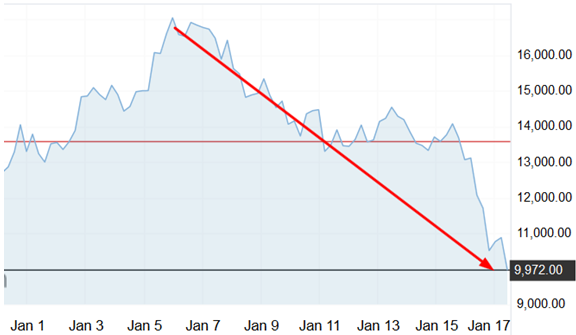
Crypto investors are seeing red this week. Bitcoin plunged to two- month lows on Thursday. dipping below $9,000 for the first time since November. At the time of writing, Bitcoin had bounced back up to the $9,200 level, down from weekly highs just above $12,000. This week has seen coins across the board in the red- a sign that investor are jumping ship to flat currency this time instead of swapping into altcoins as we've seen in the recent past.  


At the time of writing, the total cryptocurrency market cap weighed in at $459 billion, down from January highs around $830 billion . it's a contraction to be sure, but not a low for the last 30 days 


is this the bitter end for Bitcoin? for cryptos? well, no, probably not. Get your head screwed on right and you'll see that many coins have seen unprecendented growth in the last six month to a year, even with Bitcoin's price halved from holiday highs closer to $20,000. On this day last year, Bitcoin's price halved from holiday highs closer to $20,000. on this day last year, Bitcoin was sitting pretty at $982. At the height of december's craze, most reasonable crypto-watchers could agree that the price was overheated and there was only one way for it to go in the short term. still, in the thick of the current correction, Bitcoin's longer-term growth is anyone's guess.


Cryptocurrency die-hards expecting the price to bounce back, even partially, will see these tanking number as the perfect entry point for getting in low and maximizing gains. Late speculators  who got in during the mass crypto hysteria of the hoilday season aren't likely to have such steady hands, a factor that's likely contributing to the slide. .


so what's causing the slide to begin with? As usual, no one thing can be blamed for Bitcoin's current downturn, but recent skittishness around a subpoena for Bitfinex and concern around Tether __ a kind of  cryptocurrency Recent news that Facebook would ban ads for IOCs probably didn't  help either And it seems like every day a new Ponzi Scheme gets busted throwing yet more doubt on the credibility of plenty of less than legit ICOs Ever beyond news cycle highs and lows, Bitcoin has seen a few mid-January dips before,though 2017's Bitcoin behavior has seen a few mid-January dips before, though 2017's Bitcoin behavior certainly broke from any seasonal pattern of the past.


Still, these growing pains are far from surprising.As cryptocurrencies nature
assuming they continue to do so ___regulatory "bad"  news will become more common. countries across the globe will continue to struggle to accommodate their citizens' sudden interest in digital currencies. In some countries, as is the case of india, that's shaping up to be a crackdown on illegitimate activity that might also affect legitimate transactions.

Unsurprisingly, headline like these inspire a sense of foreboding among cryptocurrency enthusiast wondering which country will be next to come down hard. Fear, perhaps justified fear for many speculators with plenty to lose, amplifies each new regulatory revelation.But for cryptocurrencyies to grow out of the current scam-laden chaotic era, a thorough house cleaning is healthy.

 Bitcoin and other cryptocurrencies have also looked less responsive to positive news in the latter half of january compared to their relative buoyancy during December's dizzying highs. Then, every little positive news blip seemed to push the prices higher.  


Bitcoin aside, some altcoins might just be adjusting from overheated, overhyped December highs, Ripple is a good example of this, hovering around $1 thursday, a price that's five times its November value and only looks bad after XRP flew a bit too close to the sun with  sudden early January highs above $3. Ethereum is also faring pretty well, all things considered, down from all-time highs above $1,400 but holding most of its newly built value after doubling in price from December prices  around $500.


it'll be interesting to see what happens as we move into next week's senate banking Committee hearing on Cryptocurrency. Titled "virtual currencies: The overnight Role of the U.S, securities and Exchange commission and the U.S. commodity Future Trading commission," the open hearing will air on February 6 at 10:00 Eastern time. it's possible that upcoming discussion in congress has traders nervous, but ultimately variables from all over the globe combine to affect the market every day.     


Monday, 22 January 2018

Will bitcoin survive or not?

 Some Reasons Bitcoin Won't Survive:

Bitcoin arguably the worl's most popular cryptocurrency has endured a rough 2018 so far. After enjoying a banner year in 2017, price are down about 20% so far this year.

At around $11,500 the price of one bitcoin is more than 40% below its record high of around $20,000 touched in mid-December, wiping approximately $140 billion off its market cap. 


www.777traderesearch.com

1.Rules and Regulations

After last year's remarkable 1,900 % rally,Bitcoin has started 2018 on a rocky note. ongoing chatter of tighter rules and stricter regulations has ratted South Korea, and just this past weekend india, were the latest countries to come out charging against Bitcoin trading, with South korea's Justice minister saying that the government was considering a "ban" on cryptocurrency exchange trading.Many of india's largest private banks have suspended cryptocurrency exchange accounts tied to Bitcoin trade. law enforcement agencies in South Korea also began investigating the  country's largest exchanges for tax evasion.
china effected a similar ban last year and has recently signaled that it will escalate its calm down on cryptocurrency trading, targeting online platforms and mobile apps that offer exchange-like services.

adding to fears over rising scrutiny from global regulators, a director at Germany's central bank said this week that any attempt to regulate cryptocurrencies   must be on a global scale, as national or regional rules would be hard to enforce on a virtual, border less community.


2. Skyrocketing Fees

Skyrocketing transaction fees  fundamental changing Bitcoin. Originally, one of Bitcoin's  biggest selling points was that transaction payment would be fast, convenient and most importantly -cheap.

"The cost of mediation increases transaction cost, limiting the minimum practical transaction size and cutting off the possibility for small casual transactions," wrote Bitcoin founder Satoshi Nakamoto in the white paper announcing the technology. up until the beginning of 201, Bitcoin fees tended to be well below $1. But in recent months, its growing popularity has outstripped the network's ability to cope with soaring demand.

As a result, the Bitcoin network as we know it  today is radically different from what it was in its infancy. People are currently paying around $25 on average to make transactions using the digital currency, much higher than seen in the early days of 2017, according to data by Bit infro Charts.


3.Mining Problems

China's government is planning to shut down Bitcoin miners as part of its latest crackdown on the cryptocurrency. on January 10, the Leading group of Internet Financial Risks Remediation request that local governments make an "orderly exit" from industry.

The news is significant because China mines about 60% of the world's Bitcoin, making it by far the biggest Bitcoin mining country in the world. The fact that the majority of Bitcoin mining occurs in china could bring chaos to the Bitcoin community
Another cause for concern: one Bitcoin mining session originally created 50 Bitcoin, then the number dropped to 25 and now it stands at roughly 12.5 some forecast that by 2020, it will fall to 6.25 bitcoins which wil make mining unprofitable.

If Bitcoin isn't mined, transactions aren't approved and new Bitcoin aren't produced. Over 16,800,000 Bitcoins have been mined as of  january 13, getting close to the maximum amount of 21 million coin mined once all of the Bitcoin are mined it means supply can no longer grow.

4. Slowing Transaction Times

Right now, it takes an average time of around 200 minute to confirm a single Bitcoin transaction, according to Blockchain.com the average time for the month of December was a whopping 2,322 minutes, or roughly 38 hours, with market experts blaming the unprecedented interest in  the digital currency for clogging up the blockchain network.

Slow transaction speeds have led to a number of splitis in the original Bitcoin blockchain. In August, the blockchain was forced to split in two in an event known as a "hard work." this led to the creation of a Bitcoin spinoff called Bitcoin cash. Another fork occurred in October, birthing another Bitcoin offshoot called Bitcoin gold, as the community attempted to take measures to increase the size of blocks on the network.

in comparison, Ripple's network can the settle up to 1,500 transactions every second. other alt-coins also have the ability to enable transactions in seconds.
For instance, an Ethereum transaction takes under 20 second to confirm.

However, those figures pale in comparison to traditional paymnet service
gaints like Visa, which can confirm up to 24,000 transactions per second

Thursday, 18 January 2018

Bitcoin cryptocurrency speculative bubble is burst or emerge? analysist view.

Bitcoin speculative bubble is bursting and has a long way to fall, economists warn

Despite losing 40% in a matter of weeks the cryptocurrency still has further to drop according to experts at Capital Economics 


Bitcoin has all the hallmarks of a classic speculative bubble and even after almost halving in value in a matter of weeks it still has further to fall, according to a leading team of ecnomist.
as a regulators in south korea again signalled on thursday that they were dismissed claim that bitcoin and its imitators could replace established currencies as rubbish.

bitcoin, which rose to more that $19000 in december, recovered by 18% on Thursday after suffering  heavy losses in However, even if trading in the currencies is outlawed, Capital acknowledges that the blockchain technology behind the phenomenon will have a lasting impact.  the Luxembourg-based Bitstamp exchange shortly after 2am GMT. other cryptocurrencies include Ethereum  and Ripple.


What is bitcoin and is it a bad investment?

the currency's volatility has alamed regulators around the world and 
suggestions that it could be banned triggered the latest fall. 

 “Most people are buying Bitcoin, not because of a belief in its future as a global currency, but because they expect it to rise in value,” the note says.

Capital’s research note says the latest price falls “suggest that the bubble is bursting” although because the price was still ten times higher than it was a year ago, it still had a long way to fall.

Part of the problem, Capital says, is that despite the claims that cryptocurrencies could replace dollars and pounds one day, the surge in the price was not being driven by any strategic world view but more a simple belief that they will continue to rise in value.

Accordingly,it has all the hallmarks of a classic speculative bubble, which we expected to burst. Triggers for the bubble to burst could be a further crackdown by regulators or a major hacking attempt.

"when it will fully burst is anyone's guess and prices could yet rise again,before
they fall further ahead," they added.

the capital team,led by london-based vicky redwood and kerrie walsh, argue that even if the bubble does burst it should not have too great an impact on the global
economy because the amount of money invested in cryptocurrencies is still relatively small and they are not held by institutions.
 
in south korea,which accounts for up to 15% of daily bitcoin trading, thr chief financial regulator chif told MPs in seoul on Thursday that the goverment was considering shutting down all local virtual currency exchange, days after the idea was raised by the country's justice minister.

"The goverment is considering both shutting down all local virtual currency exchange or just the once who have been violating the law", said choi jong-ku,
chief of finanical services commission.

 the russian and the chinese goverments have also hinted at similar moves

However, even if trading in the currencies is outlawed, capital aacknowledges that the blockchain technology behind the phenomenon will have a lasting impact.